Disclosure: As an Amazon Associate I earn from qualifying purchases. The Amazon storefront links in this post may earn Power Chord Studio a commission at no extra cost to you. Prices and availability change, so check the current price on Amazon before you buy.
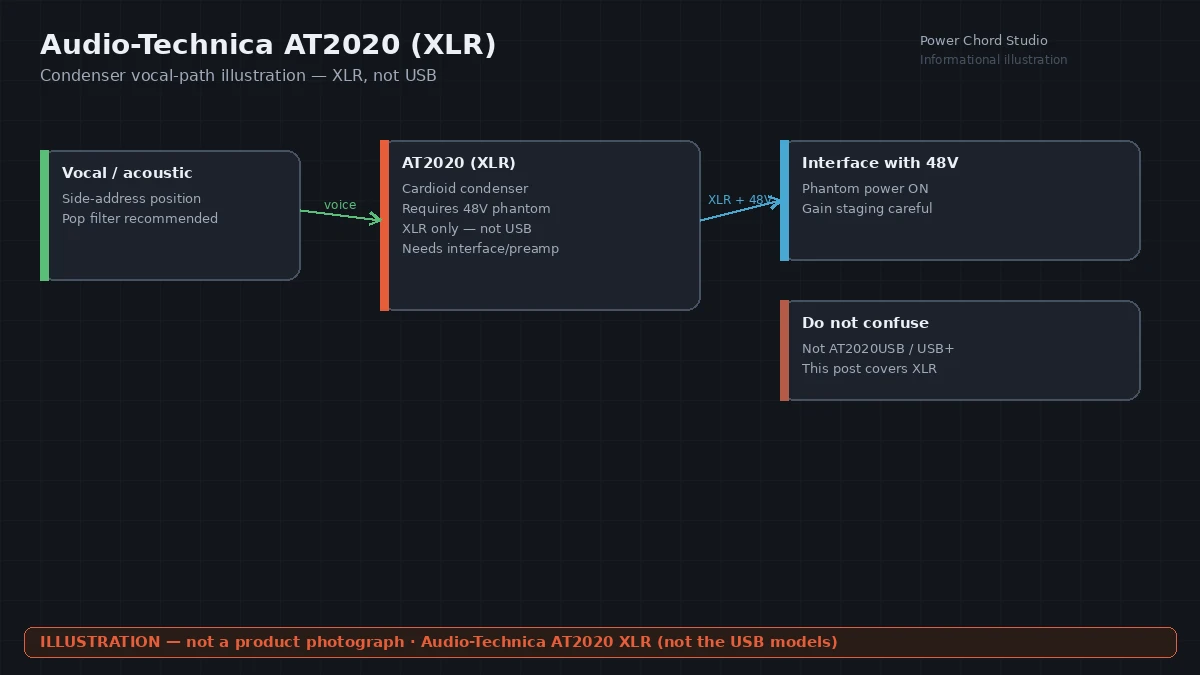
If your main job is recording sung vocals, spoken voice, or a detailed acoustic source in a reasonably controlled space, a side-address condenser is a different tool from a dynamic instrument mic. The Audio-Technica AT2020—specifically the black XLR model—is the condenser on Power Chord Studio’s microphone list.
This is the XLR AT2020, not an AT2020USB or other USB variant. Shop the Audio-Technica AT2020 (XLR) in our Amazon storefront — Microphones for Home Recording. Confirm the black XLR model, not a USB version, on that list before you buy. Full listing details are on Amazon’s product page.
What Audio-Technica specifies
On its AT2020 product page, Audio-Technica specifies a fixed-charge, permanently polarized cardioid condenser with a 20–20,000 Hz frequency response, 144 dB maximum SPL (1 kHz at 1% THD), 124 dB dynamic range, and a 74 dB signal-to-noise ratio (1 kHz at 1 Pa). It is a side-address microphone: you sing into the side of the body, not the end.
Phantom power is required: 48V DC, 2 mA typical. The output is a 3-pin XLRM connector. Audio-Technica lists the black model with a stand mount for 5/8″-27 threads, a 3/8″-16 adapter, and a soft pouch. Weight is specified at 345 g (12.1 oz).
Audio-Technica positions the AT2020 for project and home studios and for musicians, streamers, and podcasters who want a condenser’s detail. The cardioid pattern is meant to favor the source in front of the mic and reduce pickup from the sides and rear compared with an omnidirectional capsule.
Who it is a good fit for
- Singers tracking lead or harmony vocals who have (or can add) an interface with 48V phantom power.
- Acoustic guitar, light percussion, or other sources that benefit from a wider frequency response and faster transient detail than a typical dynamic instrument mic.
- Spoken-word work in a reasonably quiet, treated, or at least soft-furnished room, when you want more air and articulation than a broadcast dynamic such as the RØDE PodMic USB.
If you do not have an interface yet, pair this microphone with a 4th Gen Scarlett that can supply 48V (the Scarlett Solo for one mic, the Scarlett 2i2 for two). The AT2020 will not record by itself.
Real limitations
- It needs 48V phantom power from an interface or preamp. No phantom, no signal.
- It is not the USB AT2020. Do not order a USB version if you intend to use an XLR interface path, and do not expect this XLR model to plug into a computer without an interface.
- A more sensitive condenser, used at a typical vocal distance, will often capture more of a reflective room, a computer fan, or street noise than a less sensitive microphone used closer to the source. That is a working-distance and sensitivity effect, not proof that every dynamic microphone would be quieter in the same spot. The AT2020’s cardioid pattern reduces pickup from the rear; it does not silence a bad room.
- Side-address technique matters: aim the correct side of the body at the source and keep a consistent distance. There is no USB headphone jack on this model for zero-latency monitoring—that happens at your interface.
- A pop filter and a decent stand are wise additions even though a stand mount is included. An XLR cable is not assumed to be in the box.
- 144 dB maximum SPL is high, but that does not mean every loud source is automatically a good match. For close guitar-amp or snare work, the Shure SM57 on the same list is the instrument-oriented dynamic option.
Recording into a mix you can finish
A detailed vocal recording still needs headroom, consistent performance distance, and files that are easy to hand off. High-pass filtering later, or a mix engineer’s vocal chain, cannot invent isolation you did not capture, and they cannot undo a take that clipped on the way in. Our guide to clipped vocals and 32-bit float recording covers where that headroom actually comes from.
When the vocal is tracked, prepare the session for mixing and review what mixing versus mastering actually covers. Power Chord Studio mixing and mastering can take it from there, or start with a project note.
Shop this item in our Amazon storefront
Shop the Audio-Technica AT2020 (XLR) in our Amazon storefront — Microphones for Home Recording. Confirm the black XLR condenser, not a USB model, on the list before you buy.
You can also browse the full Power Chord Studio Amazon storefront. Full listing details are on Amazon’s product page.