Disclosure: As an Amazon Associate I earn from qualifying purchases. The Amazon storefront links in this post may earn Power Chord Studio a commission at no extra cost to you. Prices and availability change, so check the current price on Amazon before you buy.
A single microphone input is enough until the day you want two things at once: two singers, a vocal and an acoustic guitar mic, a pair of podcasters, or stereo keys. That is the line between the Scarlett Solo and the Scarlett 2i2. The standalone Focusrite Scarlett 2i2, 4th Generation, is the two-preamp option on Power Chord Studio’s interface list.
Confirm you are looking at the standalone 4th Gen 2i2, not an older generation and not a bundle. Shop the Focusrite Scarlett 2i2 (4th Gen) in our Amazon storefront — Audio Interfaces for Home Recording. Confirm the standalone fourth-generation 2i2 on that list before you buy. Full listing details are on Amazon’s product page.
What the 4th Gen 2i2 adds
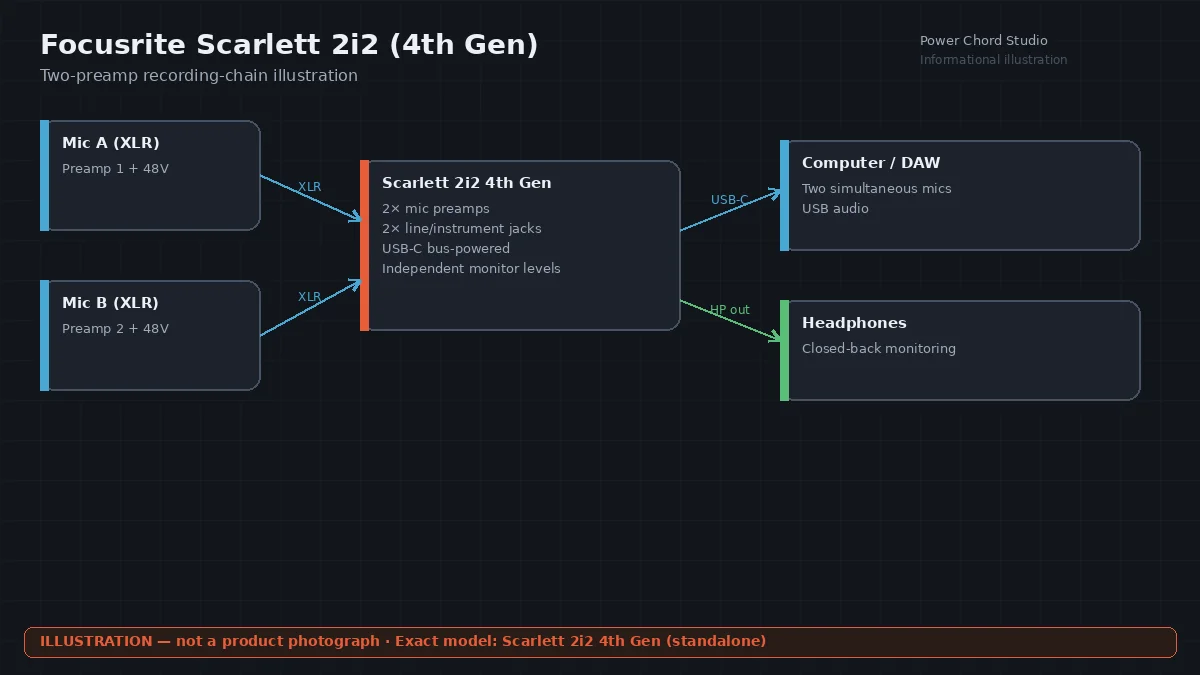
Focusrite’s 2i2 4th Gen documentation describes two remote-controllable microphone preamps. Microphone connections are Neutrik XLR inputs on the rear panel. Separate Neutrik 6.35 mm (1/4″) jack sockets on the front panel accept line- or instrument-level signals; an Inst switch sets the selected front jack to Hi-Z instrument or line. Connecting a cable to a front jack disables the corresponding rear XLR input—these are not combo jacks that accept XLR and 1/4″ in the same connector, and you cannot use both the rear XLR and the matching front jack at once. There are two balanced line outputs, one headphone output, loopback, USB-C (USB 2.0), and bus power at 900 mA. See Focusrite’s Scarlett 2i2 product page and the 2i2 4th Gen hardware features guide. An optional external 4.5 W supply is listed. Conversion is 24-bit / up to 192 kHz. Simultaneous I/O is listed as 4 × 2 including loopback.
The microphone inputs are specified at 116 dB dynamic range (A-weighted), a 69 dB gain range, 16 dBu maximum input level, and −127 dBu EIN (A-weighted). That extra gain range compared with the Solo’s published 57 dB is useful with quieter dynamic microphones.
Two features Focusrite documents on the 2i2 are Auto Gain, which sets input level for you, and Clip Safe, which lowers gain if you are about to clip (Focusrite notes Clip Safe works at sample rates up to 96 kHz). The 2i2 also has the two 4th Gen Air modes: Presence and Harmonic Drive. Focusrite Control 2 manages the interface on Windows and macOS, including from a paired mobile app while the interface stays connected to the computer.
Focusrite lists a USB-C-to-USB-A cable in the box, plus current starter software (Ableton Live Lite, Pro Tools Intro+, Cubase LE, and the Hitmaker Expansion bundle). Confirm the software offer on the listing when you buy; bundles change.
Who should choose the 2i2 over the Solo
- Duos and collaborators who need two microphones at the same time.
- Songwriters who want a dedicated vocal mic and a second mic on an acoustic guitar, amp, or room.
- Podcasters or interview setups that use two XLR microphones into one compact interface.
- Players who want two independent Hi-Z instrument inputs rather than one shared line/instrument jack.
If you will only ever record one microphone, the Scarlett Solo 4th Gen on the same list covers that job with a smaller footprint. The 2i2 is the step up when the second preamp is part of how you actually work.
Limitations to keep in view
- It is still a 2-in / 2-out desktop unit. It will not replace a larger interface if you need several microphones at once (full drum kits, multi-mic choirs, or live-band tracking).
- Auto Gain and Clip Safe help with level-setting; they do not repair a performance that overloaded the microphone capsule, and they do not replace listening while you record. For what a 32-bit float recorder can and cannot rescue, see our guide to clipped vocals and the recording path.
- Focusrite lists Windows (Intel, AMD, and Arm64) and macOS (Apple Silicon and Intel) compatibility. Verify your computer, OS, and any iPad or other host against Focusrite’s current documentation before you order.
- Like the Solo, it is specified at 900 mA USB draw. Use a port that can supply that current.
- Two preamps do not create isolation. Two open microphones in a live room will still hear each other.
How it serves the rest of your workflow
Once both sources are on separate tracks, you can balance them later instead of living with a blended live mix. That flexibility matters when you send stems out: a vocal and an acoustic guitar on their own files are much easier to mix than a single stereo bounce of everything.
When those tracks are ready, see how mixing and mastering differ and how to prepare files for a mix. If you want help finishing the record, Power Chord Studio’s mixing and mastering services are set up for independent artists.
Shop this item in our Amazon storefront
Shop the Focusrite Scarlett 2i2 (4th Gen) in our Amazon storefront — Audio Interfaces for Home Recording. Confirm the standalone fourth-generation 2i2 on the list before you buy.
You can also browse the full Power Chord Studio Amazon storefront. Full listing details are on Amazon’s product page. Questions about turning those recordings into a release? Contact Power Chord Studio.