Disclosure: As an Amazon Associate I earn from qualifying purchases. The Amazon storefront links in this post may earn Power Chord Studio a commission at no extra cost to you. Prices and availability change, so check the current price on Amazon before you buy.
Home studios often start with one “vocal mic” and then wonder why a guitar amplifier sounds distant or a snare sounds dull. Those sources are loud, directional, and close to other noise in the room. The Shure SM57 is a cardioid dynamic microphone Shure designed for that job: instruments, drums, and amplifiers, on stage and in the studio.
The listed item is the standard black XLR SM57 as a standalone microphone, not a USB microphone and not a bundle. Shop the Shure SM57 in our Amazon storefront — Microphones for Home Recording. Confirm the standalone black XLR SM57 on that list before you buy. Full listing details are on Amazon’s product page.
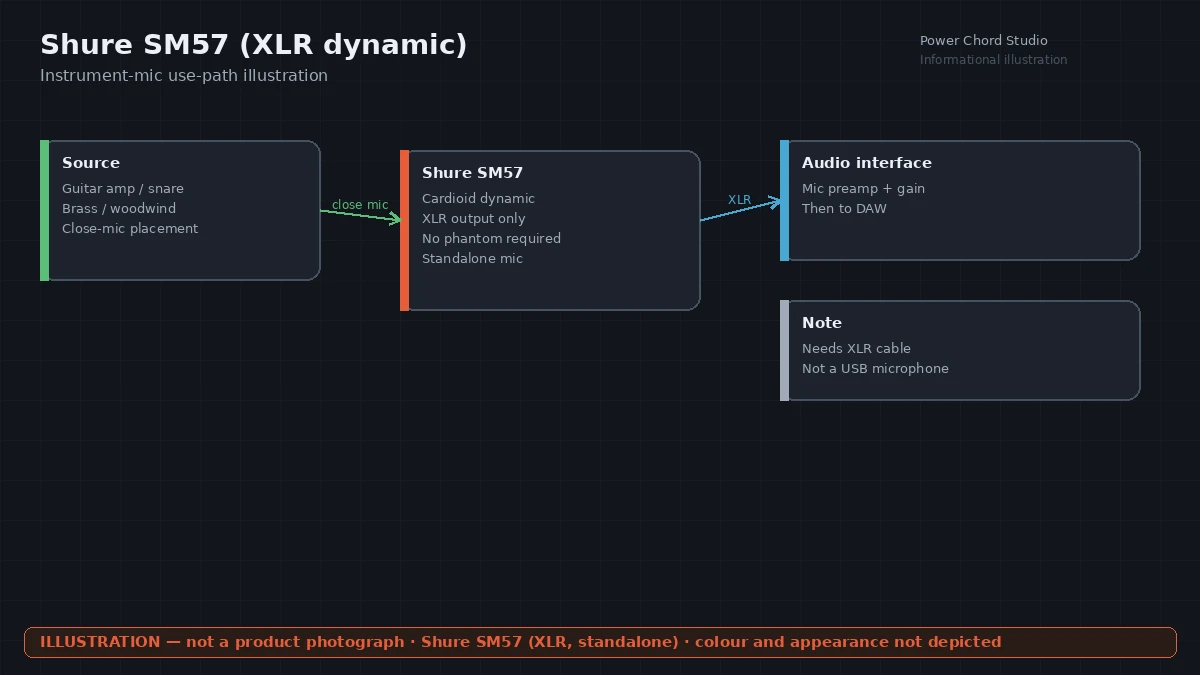
What Shure specifies
On its SM57 product page, Shure describes the SM57 as an instrument microphone with a contoured frequency response (published range 40 Hz to 15,000 Hz) and a presence rise meant to help an instrument cut through a mix. The pickup pattern is uniform cardioid, which favors what you point it at and reduces sound from the rear. A pneumatic shock-mount system is built to cut handling noise, and the body is designed for heavy use.
Shure lists it as a common choice for guitar or bass amps, saxophone, trumpet, and drums. The microphone outputs on a standard XLR connection. In the box, Shure includes an A25D swivel stand adapter and a storage bag. It does not require 48V phantom power.
Where it earns its keep
- Close-miking a guitar or bass amplifier, where sound pressure is high and you want the capsule aimed at a specific speaker area.
- Snare and other percussion, where a durable dynamic mic is a practical first choice.
- Brass and other loud acoustic instruments that benefit from a cardioid pattern and a presence lift.
- Close, loud sources where a cardioid pattern and a short working distance help keep more distant room sound lower in the balance.
The SM57’s cardioid pattern reduces pickup from the rear when you aim it carefully. That pattern—not the dynamic capsule by itself—is what rejects sound from behind the microphone. Dynamics are often placed close to a loud source, and that shorter working distance can make the direct sound stronger relative to the room. At the same distance, the same pattern, and comparable gain, a dynamic capsule does not inherently reject more room than a condenser. Placement and preamp gain still decide how much of the room you keep.
Limitations—and jobs it is not the default pick for
- It is XLR only. You need an audio interface or mixer with a microphone preamp and a separate XLR cable (cables are not assumed to be in the box).
- It is not a USB microphone and will not plug straight into a computer.
- Shure voices it as an instrument microphone. It can pick up vocals, but it is not the default choice for quiet, distant, or highly detailed sung vocals. If that is your main use, look at the Audio-Technica AT2020 (XLR) on the same list, or a speech-oriented dynamic such as the RØDE PodMic USB.
- Frequency response is specified to 15 kHz, not the extended top end many condensers advertise. That is appropriate for many instruments; it is not the same tonal balance as a studio condenser.
- Cardioid rejection is not a force field. Poor aim, too much distance, or a very loud room will still show up on the recording.
- You still have to set preamp gain so the take does not clip. A tough microphone does not make clipped audio recoverable (more on that in our guide to clipped vocals and 32-bit float).
What you need around it
Plan on an interface with at least one clean preamp—such as the Scarlett Solo or Scarlett 2i2 4th Gen on the Audio Interfaces list—plus a stand and an XLR cable. Get the capsule close to the speaker cone or drum head and listen as you move it; small changes in aim change the tone more than most EQ moves later.
Clean instrument tracks make mixing faster, whether you mix at home or send stems out. See practical home-studio mixing tips and how to prepare tracks for a professional mix. When you want help finishing, view mixing and mastering services or contact Power Chord Studio.
Shop this item in our Amazon storefront
Shop the Shure SM57 in our Amazon storefront — Microphones for Home Recording. Confirm the standard black XLR standalone microphone on the list before you buy.
You can also browse the full Power Chord Studio Amazon storefront. Full listing details are on Amazon’s product page.